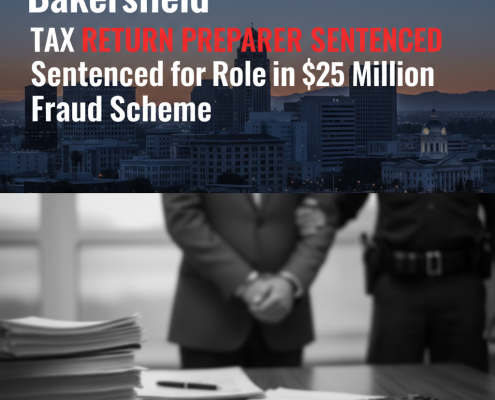
Bakersfield Tax Return Preparer Sentenced for Role in $25 Million Fraud Scheme
The U.S. Justice Department (“DOJ”) announced on November 17, 2025 that Victor Cruz, age 41, of Bakersfield, California was sentenced to 18 months in prison for participating in a scheme to submit fraudulent individual federal income tax returns that claimed $25 million in refunds.

According to court records, between November 2019 and June 2023, Miguel Martinez, 42, a Mexican national residing in the United States illegally, led a scheme to file thousands of fraudulent tax returns that claimed millions of dollars in refunds. Martinez created fake businesses that reported to the IRS phony wages paid and withholding information for supposed employees. Martinez then filed thousands of individual income tax returns in the names of the supposed employees that claimed the employees were owed refunds based on the phony wages paid and withholding information that had been reported for them.

Cruz helped Martinez carry out the scheme by preparing and filing more than 500 of the fraudulent tax returns. This was approximately 10% to 15% of the total fraudulent tax returns for which Martinez was responsible. Cruz received thousands of dollars in fees from Martinez in exchange for his services.

The IRS actually paid out $2.3 million of the $25 million in refunds that were claimed by the fraudulent tax returns.

Martinez pleaded guilty and, in September 2024, was sentenced to six years in prison.

Actions by DOJ help support IRS’ campaigns to fight refund fraud and identity theft. 

The Office of the Chief of IRS Criminal Investigation (“CI”) has previously stated that “Millions of taxpayers put their trust in tax professionals to prepare accurate and lawful returns. Unfortunately, a few bad apples take advantage of that trust for their own greed and profit. CI’s special agents are highly skilled at unraveling fraudulent schemes. With our partners in other agencies and the private sector, we are dismantling these crooked enterprises and enforcing our tax laws.”

What Should You Do?

Whether you are a victim of a tax preparer’s actions or you are tax preparer facing investigation by the federal government, it is important that you seek legal counsel as soon as possible to preserve your rights and/or mitigate your losses.  The tax attorneys of the Law Offices Of Jeffrey B. Kahn, P.C. located in Orange County (Irvine), San Francisco Bay Area (including San Jose and Walnut Creek) and elsewhere in California know exactly what to say and how to handle issues with the IRS as well as State Tax Agencies.  Our experience and expertise not only levels the playing field but also puts you in the driver’s seat as we take full control of resolving your tax problems. Also, if you are involved in cannabis, check out what our cannabis tax attorney can do for you.  Additionally, if you are involved in crypto currency, check out what a bitcoin tax attorney can do for you.Top of Form

Yes, You Can Face Jail Time For Nonpayment Of Employment Taxes

On August 27, 2025 the Treasury Inspector General for Tax Administration issued a report that looked at a lesser-known pandemic relief provision that allowed employers and self-employed individuals to defer Social Security tax payments during the pandemic.

That report stated that nearly 1.1 million employers opted to use the deferment which amounted to approximately $133 billion in Social Security taxes for Tax Year 2020.  An estimated $131 billion (98%) was paid. However, 167,373 employers had approximately $2 billion (2%) in unpaid deferrals. According to the IRS, as of May 2025, there were approximately 10,000 employers remaining who had not paid their deferral, and the IRS has assessed an estimated $591 million in penalties and interest on 403,711 tax accounts for employers who failed to timely pay their deferred Social Security taxes.  Those accounts are in Collections and subject to account enforcement.

Taxes withheld by employers account for nearly 72% of all revenue collected by the IRS, making noncompliance and cheating in this area one of the biggest problems for the nation’s tax system.

Criminal Penalties

When an employer willfully fails to pay over employment taxes, the Justice Department can pursue criminal prosecution under IRC Sec. 7202. Willful nonpayment of employment taxes is a felony under IRC Sec. 7202, punishable by a fine of up to $10,000, imprisonment up to 5 years, or both. When an employer withholds money from its employees’ paychecks and then does not pay it over to the Treasury, this act is considered embezzling money from the U.S. Treasury.

Civil Penalties

Even if the Federal government chooses not to pursue criminal prosecution, the civil penalties are still substantial.  The IRS will impose a 100% trust fund recovery penalty under IRC Sec. 6672 on “responsible persons” who were required to pay over the money or who controlled the funds that should have been deposited. Many people associated with a business may be found to be a responsible person, including corporate officers, treasurers, managers, and even bookkeepers, in certain circumstances.  These persons are held to be personally responsible for the taxes owed even when the business was conducted as a corporation or LLC.

Understanding Employment Taxes

Federal Income Tax – Employers generally must withhold federal income tax from employees’ wages with such withholding based on tables provided by IRS.

Social Security and Medicare Taxes – Employers generally must withhold part of social security and Medicare taxes from employees’ wages and you pay a matching amount yourself.

Additional Medicare Tax – Beginning January 1, 2013, employers are responsible for withholding the 0.9% Additional Medicare Tax on an employee’s wages and compensation that exceeds a threshold amount based on the employee’s filing status. You are required to begin withholding Additional Medicare Tax in the pay period in which it pays wages and compensation in excess of the threshold amount to an employee. There is no employer match for the Additional Medicare Tax.

Federal Unemployment (FUTA) Tax – Employers report and pay FUTA tax separately from Federal Income tax, and social security and Medicare taxes. You pay FUTA tax only from your own funds. Employees do not pay this tax or have it withheld from their pay.

Self-Employment Tax (SE tax) – is a social security and Medicare tax primarily for individuals who work for themselves. It is similar to the social security and Medicare taxes withheld from the pay of most employees.

Depositing And Reporting Employment Taxes

Depositing Employment Taxes

In general, you must deposit federal income tax withheld, and both the employer and employee social security and Medicare taxes.  There are two deposit schedules, monthly and semi-weekly. Before the beginning of each calendar year, you must determine which of the two deposit schedules you are required to use. If you fail to make a timely deposit, you may be subject to a failure-to-deposit penalty of up to 15%.

Deposits for FUTA Tax (Form 940) are required for the quarter within which the tax due exceeds $500. The tax must be deposited by the end of the month following the end of the quarter.

You must use electronic funds transfer (EFTPS) to make all federal tax deposits.

Reporting Employment Taxes

Generally, employers must report wages, tips and other compensation paid to an employee by filing the required form(s) to the IRS. You must also report taxes you deposit by filing Forms 940, 941 and 944 on paper or through e-file.

What Should You Do?

If you or your business owes employment taxes, it is important to get an attorney involved immediately regardless of whether your case has yet to turn criminal.  The tax attorneys of the Law Offices Of Jeffrey B. Kahn, P.C. located in Orange County (Irvine), Los Angeles and elsewhere in California know exactly what to say and how to handle issues with the IRS as well as State Tax Agencies.  Our experience and expertise not only levels the playing field but also puts you in the driver’s seat as we take full control of resolving your tax problems. Also if you are involved in cannabis, check out what a cannabis tax attorney can do for you and if you are involved in crypto-currency, check out what a Bitcoin tax attorney can do for you.

Can You Go To Jail For Not Filing Tax Returns? Beware this can happen to you.

A man who did not file tax returns for 4 years in a row pleaded guilty before a Federal District Court Judge to evading his income taxes and now must serve 8 months in jail.

As reported on October 24, 2024 by the Department Of Justice in a press release, from 2018 through 2021 John Goggins, age 63 of Chatham, New Jersey previously pleaded guilty before U.S. Magistrate Judge André M. Espinosa to a four-count information charging him with willfully failing to file federal income tax returns for tax years 2018 through 2021. Judge Espinosa imposed the sentence in Newark federal court.

According to documents filed in this case and statements made in court: Goggins was a former senior vice-president and general counsel of a large publicly traded corporation. For the years 2018 through 2021, Goggins earned total gross income of $54 million from wages, restricted stock awards, the exercise of annual nonqualified stock options, interest, dividends, and gains from stock sales. Nevertheless, Goggins failed to file federal income tax returns for those years.

In addition to the prison term, Judge Espinosa sentenced Goggins to one year of supervised release, ordered restitution to the IRS of $3.11 million, which has already been paid, and fined him $40,000.

An Opportunity To “Get Back Into The System” And Be Compliant.

Our tax system relies on initial voluntary compliance where taxpayers each year file a tax return; however, there are millions of Americans who fail to file a tax return and what’s worse is that these failures are not limited to just one year. Taxpayers who either have never filed a tax return or those who were once compliant but stopped filing a tax return for a period of time, face the same penalties.  Additionally, if the IRS chooses to pursue criminal prosecution and proves that the failure was willful, a taxpayer can be sentenced to prison.  So it is important to engage a tax attorney to come up with a plan to mitigate criminal exposure and establish an arrangement or settlement on the resulting tax liabilities.

An Opportunity For Taxpayers Who Owe The IRS.

As a prerequisite to any proposal (including but not limited to, an Offer In Compromise, payment plan or being put into “uncollectible status”) to the IRS, you must be in current compliance. That means if you have any outstanding income tax returns, they must be completed and submitted to IRS.

Also, if you are required to make estimated tax payments, you must be current in making those payments. Since we are in 2025, taxpayers who expect to owe for 2024 should have their 2024 income tax returns as soon as possible so that the 2024 liability can be rolled over into any proposal.  Unfortunately, your obligation to make estimated tax payments for 2025 cannot be included in your proposal and the IRS will require as a prerequisite that you are current on these payments (1st quarter 2025 is due April 15, 2025).

All taxpayers should continue to meet their tax obligations as normal. Individuals and businesses should keep filing their tax returns and making payments and deposits with the IRS, as they are required to do.

Also, the IRS will continue to take steps where necessary to protect all applicable statutes of limitations. In instances where statute expirations might be jeopardized during this period and a taxpayer is not agreeing to extend such, the IRS will issue Notices of Deficiency and pursue other similar actions to protect the interests of the government in preserving such statute.

What Should You Do?

You know that at the Law Offices Of Jeffrey B. Kahn, P.C. we are always thinking of ways that our clients can save on taxes. If you are selected for an audit, stand up to the IRS by getting representation. Tax problems are usually a serious matter and must be handled appropriately so it’s important to that you’ve hired the best lawyer for your particular situation. The tax attorneys at the Law Offices Of Jeffrey B. Kahn, P.C. located in Orange County (Irvine), Los Angeles (including Long Beach and Ontario) and elsewhere in California are highly skilled in handling tax matters and can effectively represent at all levels with the IRS and State Tax Agencies including criminal tax investigations and attempted prosecutions, undisclosed foreign bank accounts and other foreign assets, and unreported foreign income. Also if you are involved in cannabis, check out what a cannabis tax attorney can do for you.  And if you are involved in crypto currency, check out what a bitcoin tax attorney can do for you.

Can You Go To Jail For Not Filing Tax Returns? Beware this can happen to you.

Can You Go To Jail For Not Filing Tax Returns? Beware this can happen to you.

A man who did not file tax returns for 8 year in a row pleaded guilty before a Federal District Court Judge to evading his income taxes and now must serve 57 months in jail.

As reported by the Department Of Justice in a press release, from 2009 through 2016 Daryl Brown received taxable income, but did not file tax returns reporting his income or pay the taxes he owed.  To evade his taxes, Mr. Brown opened bank accounts and lines of credit in nominee names and used credit and debit cards from those accounts to pay for personal expenses.  He also bought money orders with cash, directed others to buy money orders for him, and structured his purchase of money orders–sometimes from several locations on the same day–to avoid triggering reporting requirements that would have flagged his activity to the IRS.  Court documents showed Mr. Brown’s conduct caused a tax loss of more than $250,000 to the IRS.

The Department Of Justice in a follow-up press release reported that on June 7, 2021 U.S. District Judge Timothy S. Black in the Southern District of Ohio sentenced Mr. Brown to 57 months in prison for tax evasion and ordered him to serve 3 years of supervised release and pay restitution to the IRS in the amount of $377,240.

An Opportunity To “Get Back Into The System” And Be Compliant.

Our tax system relies on initial voluntary compliance where taxpayers each year file a tax return; however, there are millions of Americans who fail to file a tax return and what’s worse is that these failures are not limited to just one year. Taxpayers who either have never filed a tax return or those who were once compliant but stopped filing a tax return for a period of time, face the same penalties.  Additionally, if the IRS chooses to pursue criminal prosecution and proves that the failure was willful, a taxpayer can be sentenced to prison.  So it is important to engage a tax attorney to come up with a plan to mitigate criminal exposure and establish an arrangement or settlement on the resulting tax liabilities.

An Opportunity For Taxpayers Who Owe The IRS.

As a prerequisite to any proposal (including but not limited to, an Offer In Compromise, payment plan or being put into “uncollectible status”) to the IRS, you must be in current compliance. That means if you have any outstanding income tax returns, they must be completed and submitted to IRS.

Also, if you are required to make estimated tax payments, you must be current in making those payments. Since we are in summer of 2023, taxpayers who expect to owe for 2022 should have their 2022 income tax returns as soon as possible so that the 2022 liability can be rolled over into any proposal.  Unfortunately, your obligation to make estimated tax payments for 2023 cannot be included in your proposal and the IRS will require as a prerequisite that you are current on these payments (1st quarter 2023 was due April 17, 2023 and 2nd quarter was due June 15, 2023).

All taxpayers should continue to meet their tax obligations as normal. Individuals and businesses should keep filing their tax returns and making payments and deposits with the IRS, as they are required to do.

Also, the IRS will continue to take steps where necessary to protect all applicable statutes of limitations. In instances where statute expirations might be jeopardized during this period and a taxpayer is not agreeing to extend such, the IRS will issue Notices of Deficiency and pursue other similar actions to protect the interests of the government in preserving such statute.

What Should You Do?

You know that at the Law Offices Of Jeffrey B. Kahn, P.C. we are always thinking of ways that our clients can save on taxes. If you are selected for an audit, stand up to the IRS by getting representation. Tax problems are usually a serious matter and must be handled appropriately so it’s important to that you’ve hired the best lawyer for your particular situation. The tax attorneys at the Law Offices Of Jeffrey B. Kahn, P.C. located in Orange County (Irvine), Los Angeles (including Long Beach and Ontario) and elsewhere in California are highly skilled in handling tax matters and can effectively represent at all levels with the IRS and State Tax Agencies including criminal tax investigations and attempted prosecutions, undisclosed foreign bank accounts and other foreign assets, and unreported foreign income. Also if you are involved in cannabis, check out what a cannabis tax attorney can do for you.  And if you are involved in crypto currency, check out what a bitcoin tax attorney can do for you.


Florida Tax Preparer Sentenced To Prison For Criminal Contempt

Florida Tax Preparer Sentenced To Prison For Criminal Contempt

Tax Preparer Defied Court Injunction Prohibiting the Filing of IRS Returns.

A Florida man was sentenced to one year and one day in prison on August 25, 2022 for criminal contempt for continuing to prepare and file tax returns with the IRS in violation of a federal court order barring him from doing so.

Tax Houses And Accounting Services of Lauderdale Lakes, Florida

The Tax Division of the U.S. Justice Department (“DOJ”) announced that on August 25, 2022, a federal court in the Southern District of Florida issued the sentence on Guy Telfort, of Fort Lauderdale, Florida, who previously owned and operated Tax Houses and Accounting Services, a Lauderdale Lakes tax preparation business.

The announcement relying on court documents and statements made in court states that from approximately January 2015 through April 2019, Telfort and his employees prepared and filed tax returns for clients. In order to generate inflated IRS refunds for clients, some of these returns reported false items, including fictitious business income and losses and mileage deductions. On April 24, 2019, the U.S. District Court for the Southern District of Florida entered an injunction against Telfort in a civil proceeding, permanently barring Telfort from preparing federal tax returns for others.

Despite this court-ordered injunction, in 2020 and 2021, Telfort continued to prepare and file returns, working out of an Oakland Park, Florida, pawn shop. Telfort charged clients as much as $1,000 for each return filed with the IRS. Some of these tax returns reported false medical and dental expenses and charitable contributions, as well as fictitious businesses. To disguise his role in preparing these returns, Telfort used IRS Preparer Tax Identification Numbers belonging to other tax preparers. Over the two-year period, Telfort prepared nearly 1,200 tax returns for clients in willful violation of the permanent injunction.

In addition to the term of imprisonment, U.S. District Judge Federico A. Moreno ordered Telfort to serve three years of supervised release and pay $762,338.88 in restitution to the United States.

Actions by DOJ help support IRS’ campaigns to fight refund fraud and identity theft. 

“Identity theft is a pervasive crime and stopping it remains a top priority of the IRS,” said IRS Commissioner Chuck Rettig. “The IRS, with the help of our Security Summit partners, continues to make progress in this area, but we need to continue our significant efforts to protect taxpayers and assist those who have been a victim of identity theft. We are fighting this problem with enhanced systems, smarter technology and the efforts of our dedicated workforce, including Criminal Investigation. We will retain our relentless, vigorous pursuit of those who prey upon others in this arena”.

The Office of the Chief of IRS Criminal Investigation (“CI”) has previously stated that “Millions of taxpayers put their trust in tax professionals to prepare accurate and lawful returns. Unfortunately, a few bad apples take advantage of that trust for their own greed and profit. CI’s special agents are highly skilled at unraveling fraudulent schemes. With our partners in other agencies and the private sector, we are dismantling these crooked enterprises and enforcing our tax laws.”

What Should You Do?

Whether you are a victim or the perpetrator of identity theft or refund fraud, it is important that you seek legal counsel as soon as possible to preserve your rights and/or mitigate your losses.  The tax attorneys of the Law Offices Of Jeffrey B. Kahn, P.C. located in Orange County (Irvine), San Francisco Bay Area (including San Jose and Walnut Creek) and elsewhere in California know exactly what to say and how to handle issues with the IRS as well as State Tax Agencies.  Our experience and expertise not only levels the playing field but also puts you in the driver’s seat as we take full control of resolving your tax problems. Also, if you are involved in cannabis, check out what our cannabis tax attorney can do for you.  Additionally, if you are involved in crypto currency, check out what a bitcoin tax attorney can do for you.

How To Know When You May Be A Target In An IRS Criminal Investigation

How To Know When You May Be A Target In An IRS Criminal Investigation

A simple mistake, oversight, or your accountant’s malpractice may trigger an IRS criminal investigation. Specifically, unreported income, mismatch of information on a tax return versus third-party reporting information, a false statement, the use of an impermissible accounting or banking service, or declaring too many deductions are things that could initiate an audit, which could then rise to the level of an IRS criminal investigation.

The IRS is the world’s most powerful collection agency, with tremendous resources, and its Criminal Investigation Division (CID) is ruthless. CID conducts criminal investigations regarding alleged violations of the Internal Revenue Code, the Bank Secrecy Act and various money laundering statutes. The findings of these investigations are referred to the Department of Justice (DOJ) for recommended prosecution.

A criminal investigation differs from an audit. With an audit, the IRS attempts to determine whether you have calculated your tax liability correctly. With a criminal investigation, the IRS seeks to mount a case against you (the “target”) so that the DOJ can prosecute you and hold you out as an example to others as to what will happen if you cheat the government.

The IRS Criminal Investigation Process

The IRS criminal investigation process is serious business. CID is composed of federal agents (called “Special Agents”), who are highly trained financial investigators that carry a gun and wear a badge. Unlike your typical police department, CID conducts a very thorough investigation which may last years while they interview a target’s family, friends, co-workers, employees, and business associates, and bankers, among others, to acquire evidence as to the extent of the tax evasion or tax fraud that may have occurred by the target.

When the Special Agents come to interview a target’s family, friends, co-workers, employees, and business associates, and bankers, etc., they likely consider you to be a “witness” and they are merely looking for information that would be useful in their investigation of the target.  Seems not concerning, but if your actions or position helped the target commit an alleged tax crime or it turns out that you as a witness have your own tax exposure, you now could be designated as an additional target by the Special Agents.

Special agents analyze information to determine if criminal tax fraud or some other financial crime may have occurred. Relevant information is evaluated. This preliminary process is called a “primary investigation”. The special agent’s front line supervisor reviews the preliminary information and makes the determination to approve or decline the further development of the information. If the supervisor approves, approval is obtained from the head of the office, the special agent in charge, to initiate a “subject criminal investigation”.

After all the evidence is gathered and analyzed, if the special agent and his or her supervisor determine that the evidence is sufficient to support the recommendation of prosecution, the agent proceeds with the preparation of a written report detailing the findings of violation of the law and recommending prosecution.  The report is then forwarded to DOJ who if the case is accepted will initiate criminal prosecution to ultimately get a conviction.

A criminal tax violation conviction results in severe consequences, and in addition to monstrous fines, including the cost of prosecution and jail time.  Each count can result in five years in jail and it could spell financial, personal and social ruin. Compounding the situation is that often a taxpayer will not know when he is subject to an IRS criminal investigation until it is in its late stages at which time they surely have made incriminating admissions if they were not represented by competent counsel.

 Signs that You May Be A Target in an IRS Criminal Investigation –

(1) An IRS Revenue Officer abruptly stops pursuing you after he has been requesting you to pay your IRS tax debt, and now does not return your calls. The agent might be getting ready to refer your case to the CID to investigate previous or current tax evasion or crimes you may have committed within the collection process. (i.e., making false statements, hiding income or assets).

(2) An IRS Revenue agent has been auditing you and now disappears for days or even weeks at a time. After a case is referred to the CID, both the Collection and Examination Divisions put things on “pause” because they do not want to jeopardize a successful criminal prosecution. CID is incredibly resourceful and tactful. To better position yourself against them, it is best to obtain an experienced IRS tax attorney as early as possible where criminal tax exposure is apparent in your fact pattern (like where you know you cheated on the return that is under audit). This is true even if your case is only at the civil investigation stage.

(3) Your bank informs you that your records have been summoned by the CID or subpoenaed by the U.S. Attorney’s Office.

(4) Your accountant is contacted by Special Agents, or has been subpoenaed to appear before a grand jury and told to bring your tax records. Unfortunately, the “accountant-client privilege” simply does not protect you in a criminal case and any statements made to your accountant can be used against you in a criminal investigation, either through the “discovery” process leading to trial or where the accountant is called as a witness during criminal tax trial.

What Should You Do?

Whether and when to answer questions from the IRS, or whether to stand on your 5th Amendment rights, are questions that only a tax fraud lawyer can help you answer. Your financial well being, as well as your personal freedom may depend on the right answers. If you or your accountant even suspects that you might be subject to a criminal or civil tax fraud penalty, you should seek help immediately.

The tax attorneys at the Law Offices Of Jeffrey B. Kahn, P.C. located in Orange County (Irvine), Los Angeles (including Long Beach and Ontario) and elsewhere in California are highly skilled in handling tax matters and can effectively represent at all levels with the IRS and State Tax Agencies including criminal tax investigations and attempted prosecutions, undisclosed foreign bank accounts and other foreign assets, and unreported foreign income. You can also check out the KahnTaxLaw Coronavirus Resource Center.  Also if you are involved in cannabis, check out what a cannabis tax attorney can do for you.  And if you are involved in crypto currency, check out what a bitcoin tax attorney can do for you.

Can You Go To Jail For Not Filing Tax Returns? Beware this can happen to you.

Can You Go To Jail For Not Filing Tax Returns? Beware this can happen to you.

A man who did not file tax returns for 8 year in a row pleaded guilty before a Federal District Court Judge to evading his income taxes and now must serve 57 months in jail.

As reported by the Department Of Justice in a press release, from 2009 through 2016 Daryl Brown received taxable income, but did not file tax returns reporting his income or pay the taxes he owed.  To evade his taxes, Mr. Brown opened bank accounts and lines of credit in nominee names and used credit and debit cards from those accounts to pay for personal expenses.  He also bought money orders with cash, directed others to buy money orders for him, and structured his purchase of money orders–sometimes from several locations on the same day–to avoid triggering reporting requirements that would have flagged his activity to the IRS.  Court documents showed Mr. Brown’s conduct caused a tax loss of more than $250,000 to the IRS.

The Department Of Justice in a follow-up press release reported that on June 7, 2021 U.S. District Judge Timothy S. Black in the Southern District of Ohio sentenced Mr. Brown to 57 months in prison for tax evasion and ordered him to serve 3 years of supervised release and pay restitution to the IRS in the amount of $377,240.

An Opportunity To “Get Back Into The System” And Be Compliant.

Our tax system relies on initial voluntary compliance where taxpayers each year file a tax return; however, there are millions of Americans who fail to file a tax return and what’s worse is that these failures are not limited to just one year. Taxpayers who either have never filed a tax return or those who were once compliant but stopped filing a tax return for a period of time, face the same penalties.  Additionally, if the IRS chooses to pursue criminal prosecution and proves that the failure was willful, a taxpayer can be sentenced to prison.  So it is important to engage a tax attorney to come up with a plan to mitigate criminal exposure and establish an arrangement or settlement on the resulting tax liabilities.

An Opportunity For Taxpayers Who Owe The IRS.

As a prerequisite to any proposal (including but not limited to, an Offer In Compromise, payment plan or being put into “uncollectible status”) to the IRS, you must be in current compliance. That means if you have any outstanding income tax returns, they must be completed and submitted to IRS.

Also, if you are required to make estimated tax payments, you must be current in making those payments. Since we are in summer of 2022, taxpayers who expect to owe for 2021 should have their 2021 income tax returns as soon as possible so that the 2021 liability can be rolled over into any proposal.  Unfortunately, your obligation to make estimated tax payments for 2022 cannot be included in your proposal and the IRS will require as a prerequisite that you are current on these payments (1st quarter 2022 was due April 17, 2022 and 2nd quarter was due June 15, 2022).

Remember that COVID-19 does not alter the tax laws, so all taxpayers should continue to meet their tax obligations as normal. Individuals and businesses should keep filing their tax returns and making payments and deposits with the IRS, as they are required to do.

Also, the IRS will continue to take steps where necessary to protect all applicable statutes of limitations. In instances where statute expirations might be jeopardized during this period and a taxpayer is not agreeing to extend such, the IRS will issue Notices of Deficiency and pursue other similar actions to protect the interests of the government in preserving such statute.

What Should You Do?

You know that at the Law Offices Of Jeffrey B. Kahn, P.C. we are always thinking of ways that our clients can save on taxes. If you are selected for an audit, stand up to the IRS by getting representation. Tax problems are usually a serious matter and must be handled appropriately so it’s important to that you’ve hired the best lawyer for your particular situation. The tax attorneys at the Law Offices Of Jeffrey B. Kahn, P.C. located in Orange County (Irvine), Los Angeles (including Long Beach and Ontario) and elsewhere in California are highly skilled in handling tax matters and can effectively represent at all levels with the IRS and State Tax Agencies including criminal tax investigations and attempted prosecutions, undisclosed foreign bank accounts and other foreign assets, and unreported foreign income. You can also check out the KahnTaxLaw Coronavirus Resource Center.  Also if you are involved in cannabis, check out what a cannabis tax attorney can do for you.  And if you are involved in crypto currency, check out what a bitcoin tax attorney can do for you.

Five Tax Shelter Promoters and Two Appraisers Indicted in Syndicated Conservation Easement Tax Scheme

Five Tax Shelter Promoters and Two Appraisers Indicted in Syndicated Conservation Easement Tax Scheme

Conspiracy Allegedly Involved Sale of Over $1.3 Billion in Fraudulent Tax Deductions

The U.S. Justice Department (“DOJ”) announced on March 1, 2022 that a federal grand jury sitting in Atlanta, Georgia, returned a superseding indictment on February 24, 2022 charging seven individuals with conspiracy to defraud the United States and other crimes arising out of their promotion of fraudulent tax shelters involving syndicated conservation easements dating back nearly two decades. One of the defendants, Herbert Lewis, was previously charged in an indictment returned on June 9, 2021.

Alleged Syndicated Conservation Easement Tax Scheme

According to the superseding indictment, Jack Fisher, an Atlanta certified public accountant (CPA); James Sinnott; Yekaterina Lopuhina, aka “Kate Joy;” Lewis, an Atlanta-area CPA; Victor Smith, an Atlanta-area CPA; Clayton Weibel, a licensed appraiser; and Walter D. Roberts II, aka “Terry Roberts,” a licensed appraiser, engaged in a conspiracy to design, market and sell false and fraudulent charitable contribution tax deductions to high-income clients.

Fisher and Sinnott allegedly caused partnerships to donate conservation easements over land owned by the partnerships. In conjunction with those donations, Fisher and Sinnott allegedly used two hand-picked appraisers, Weibel and Roberts, to generate fraudulent and inflated appraisals of the conservation easements that frequently valued the easements at amounts at least 10 times higher than the price that was actually paid for the partnership — often within months of the appraisals. According to the superseding indictment, the partnerships then claimed a charitable contribution tax deduction in the inflated amount of the conservation easement, resulting in a fraudulent tax deduction flowing to the clients who purchased units in the partnership.

Fisher, Sinnott, Joy, Lewis, Smith and other co-conspirators allegedly promoted, marketed and sold partnership units for $25,000 and guaranteed at least a 4-to-1 tax deduction ratio to their clients, which meant that four units with a total cost of $100,000 would yield a $400,000 tax deduction. The marketing materials allegedly stated, for example, that depending on their personal tax rate, such a $400,000 deduction could result in the client receiving $170,000 back within months of purchasing their units for $100,000. Fisher, Sinnott and Joy allegedly provided Roberts and Weibel with spreadsheets containing information purportedly used to value the conservation easements necessary to deliver the tax deduction ratio promised to their clients.

Indictment Details

The superseding indictment charges that the syndicated conservation easement transactions were abusive tax shelters lacking in economic substance or a business purpose. Despite Fisher, Sinnott and Joy allegedly attempting to disguise the transactions as real estate deals, the indictment alleges that the transactions were simply the illegal sale of inflated tax deductions.

Additionally, Fisher, Sinnott, Joy, Lewis and Smith allegedly helped clients claim charitable contribution tax deductions after the close of the tax year by accepting late sales, generating backdated documents and preparing, and causing the preparation of, false and fraudulent tax returns and false documents, among other items. In total, the defendants allegedly sold over $1.3 billion in false and fraudulent tax deductions through this scheme.

All defendants are charged with conspiring to defraud the United States, for which they face a maximum sentence of 5 years in prison.

In addition, Fisher, Sinnott, Joy, Roberts and Weibel are charged with one count of conspiracy to commit wire fraud, for which each faces a maximum sentence of 20 years in prison if convicted. Lewis and Smith are both charged with wire fraud, for which they each face a maximum sentence of 20 years in prison for each count.

Fisher, Sinnott, Lewis, Smith, Roberts and Weibel are charged with aiding and assisting in the preparation of false returns related to the syndicated conservation easement tax shelters, for which they face a maximum sentence of 3 years in prison for each count.

Fisher, Sinnott, Joy and Lewis are also charged with filing false personal tax returns, for which they each face a maximum sentence of 3 years in prison for each count.

Finally, Fisher is charged with money laundering arising from his purchases of multiple luxury vehicles and domestic and foreign properties with the proceeds of unlawful activity. He faces a maximum sentence of 10 years in prison for each count.

In addition to the statutory maximum periods of incarceration, each of the defendants also faces a period of supervised release, monetary penalties, restitution and forfeiture. A federal district court judge will determine any sentence after considering the U.S. Sentencing Guidelines and other statutory factors.

** Keep in mind that an indictment is merely an allegation, and all defendants are presumed innocent until proven guilty beyond a reasonable doubt in a court of law. **

Actions by DOJ help support IRS’ campaigns to fight fraudulent tax shelters.

Acting Deputy Assistant Attorney General Stuart M. Goldberg of the Justice Department’s Tax Division stated: “The Tax Division is continuing to prioritize prosecution of fraudulent tax shelters, which are designed to enable taxpayers to pay far less than their fair share.  Those who contemplate promoting fraudulent tax shelters involving syndicated conservation easements – and the accountants, appraisers and tax preparers who create and execute strategies to assist them – should know that the Tax Division and IRS will unravel even the most elaborate schemes.”

Chief Jim Lee of IRS Criminal Investigation (IRS-CI) stated: “This superseding indictment demonstrates IRS Criminal Investigation’s commitment to investigate and prosecute illegal tax shelters.  IRS-CI special agents are focused on ending abusive syndicated conservation easements that allow perpetrators of these schemes to enrich themselves while their wealthy clients skirt their tax obligations.”

What Should You Do?

Whether you are a involved in a potentially fraudulent tax shelter or the promoter of one, it is important that you seek legal counsel as soon as possible to preserve your rights and/or mitigate your losses.  The tax attorneys of the Law Offices Of Jeffrey B. Kahn, P.C. located in Orange County (Irvine), San Francisco Bay Area (including San Jose and Walnut Creek) and elsewhere in California know exactly what to say and how to handle issues with the IRS as well as State Tax Agencies.  Our experience and expertise not only levels the playing field but also puts you in the driver’s seat as we take full control of resolving your tax problems. Also, if you are involved in cannabis, check out what our cannabis tax attorney can do for you.  Additionally, if you are involved in crypto currency, check out what a bitcoin tax attorney can do for you.Top of Form

Justice Department Shuts Down Brooklyn Tax Return Preparation Business

Justice Department Shuts Down Brooklyn Tax Return Preparation Business

Recently, the U.S. Justice Department (“DOJ”) successfully secured injunctions from U.S Federal District Court for the Eastern District of New York barring Keith Sang, Kashana Sang, Tareek Lewis, Kimberly Brown and their business K&L Accounting Inc. from preparing tax returns.

K&L Accounting Inc. of Brooklyn, New York

The Tax Division of the DOJ announced that on February 26, 2022, a federal court in the Eastern District of New York issued a preliminary injunction against four Brooklyn tax return preparers and their business.

The civil complaint filed in the case seeks to permanently bar Keith Sang, Kashana Sang, Tareek Lewis, Kimberly Brown and their business K&L Accounting Inc. from preparing tax returns. The preliminary injunction bars the defendants from any involvement in the preparation of federal tax returns during the pendency of this case. Keith Sang, Kashana Sang, Lewis and the business made no objection to the injunction. Brown opposed it.

The complaint alleges that the defendants’ tax return preparation schemes include preparation of individual income tax returns that (1) contain false or exaggerated itemized deductions (for example, unreimbursed employee expenses and charitable donations), (2) false filing statuses, such as improper “head of household” elections, (3) fraudulent and/or fictitious business income and/or expenses, (4) returns that falsify customer’s self-employment income to bring the customer into the “sweet spot” for the maximum available earned income tax credit, and (5) false losses on forms that report supplemental income or loss. The complaint alleges that, each year, K&L is responsible for preparing over 2,000 tax returns for customers, and that Keith Sang, whose electronic tax filing privileges were revoked years ago, has taken numerous steps to disguise his involvement with the tax return preparation, while he continues to prepare returns and supervise others working at K&L.

In granting the preliminary injunction, the court found that defendants engaged in concerted and conscious steps to evade IRS enforcement; that they, acting as a unit, repeatedly filed tax returns understating taxpayer liabilities since at least 2016; and that their past efforts demonstrated that they would continue hampering IRS enforcement unless prohibited from acting as federal tax return preparers during the litigation.

Actions by DOJ help support IRS’ campaigns to fight refund fraud and identity theft. 

“Identity theft is a pervasive crime and stopping it remains a top priority of the IRS,” said IRS Commissioner Chuck Rettig. “The IRS, with the help of our Security Summit partners, continues to make progress in this area, but we need to continue our significant efforts to protect taxpayers and assist those who have been a victim of identity theft. We are fighting this problem with enhanced systems, smarter technology and the efforts of our dedicated workforce, including Criminal Investigation. We will retain our relentless, vigorous pursuit of those who prey upon others in this arena”.

The Office of the Chief of IRS Criminal Investigation (“CI”) has previously stated that “Millions of taxpayers put their trust in tax professionals to prepare accurate and lawful returns. Unfortunately, a few bad apples take advantage of that trust for their own greed and profit. CI’s special agents are highly skilled at unraveling fraudulent schemes. With our partners in other agencies and the private sector, we are dismantling these crooked enterprises and enforcing our tax laws.”

What Should You Do?

Whether you are a victim of identity theft or the perpetrator of identity theft, it is important that you seek legal counsel as soon as possible to preserve your rights and/or mitigate your losses.  The tax attorneys of the Law Offices Of Jeffrey B. Kahn, P.C. located in Orange County (Irvine), San Francisco Bay Area (including San Jose and Walnut Creek) and elsewhere in California know exactly what to say and how to handle issues with the IRS as well as State Tax Agencies.  Our experience and expertise not only levels the playing field but also puts you in the driver’s seat as we take full control of resolving your tax problems. Also, if you are involved in cannabis, check out what our cannabis tax attorney can do for you.  Additionally, if you are involved in crypto currency, check out what a bitcoin tax attorney can do for you.Top of Form

Justice Department Shuts Down Three Tax Return Preparation Businesses

Justice Department Shuts Down Three Tax Return Preparation Businesses

Recently in three separate cases, the U.S. Justice Department (“DOJ”) successfully secured injunctions from U.S Federal District Courts barring certain tax return preparation businesses from preparing tax returns and in some cases ordering the tax return preparers to disgorge the fees they obtained by preparing false and fraudulent tax returns.

Terance Price – Mississippi

On January 28, 2022, DOJ announced that a federal court in the Southern District of Mississippi has permanently barred Terance Price, a Mississippi tax return preparer, from owning or operating a tax return preparation business and preparing tax returns for others.

The permanent injunction is against Terance Price, both individually and doing business as Superior Taxes. The court entered the injunction after Price failed to respond to the complaint the government served on him.

The complaint alleged that Price, who began operating his tax preparation business in 2015, knowingly took unreasonable positions on returns he prepared that understated the tax his customers owed, overstated the refunds owed to his clients, or both. In particular, the complaint alleged that Price prepared returns that falsely claimed residential energy credits, fuel tax credits and unreimbursed employee business expenses.

The government further alleged in the complaint that Price has filed hundreds of tax returns since 2015, and that he has filed tax returns using other tax preparers’ personal identifying information. According to the complaint, the IRS assessed penalties against Price for failing to make reasonable inquiries to ensure that his customers were legitimately entitled to various tax credits, and Price has not paid those penalties.

Karla Welch – Florida

On February 2, 2022, DOJ announced that it filed a civil injunction suit to bar Karla Welch and her businesses from owning or operating a tax preparation business and preparing tax returns. The complaint also requests that the court require the defendants to disgorge the fees they obtained by preparing false and fraudulent tax returns.

The complaint, filed in the U.S. District Court for the Middle District of Florida, alleges that Welch, through Karla R. Welch LLC and Kwik Services LLC, owns and operates a tax preparation business with as many as 12 stores in Florida, Georgia and North Carolina. According to the complaint, Welch and her businesses prepare and file tax returns to falsely increase their customers’ refunds, and profit through high and often undisclosed preparation fees at the expense of their customers and the Treasury. The complaint alleges that the defendants prepared returns for customers that:

  • Falsely claim the Earned Income Tax Credit
  • Report fabricated businesses and related business income and expenses
  • Report fabricated deductions, including for purported job-related expenses
  • Claim false education credits.

Wendell Devallon and Berald Dominique – Florida

On February 4, 2022, DOJ announced that a federal court in the Southern District of Florida permanently as of February 3, 2022 barred Wendell Devallon and Berald Dominique, co-owners of Tax Time Group Inc., from preparing federal income tax returns or operating any tax return preparation business in the future. The court also ordered the tax preparers to pay $353,000 in disgorgement to the United States.

The civil complaint filed in the case alleged that Wendell Devallon and Berald Dominique, co-owners of Tax Time Group Inc., prepared tax returns for customers that claimed fraudulent self-employment expenses, fictitious education credits, false fuel tax credits and fake charitable contributions, among other schemes. The complaint also alleged that Devallon and Dominique acted as “ghost” preparers, meaning that they acted as paid tax return preparers but did not sign the returns they prepared, as required by law.

In a June 2021 order, the court found the defendants in contempt for violating a preliminary injunction that restricted their tax preparation activities while this case was pending. Devallon, Dominique and Tax Time Group consented to entry of the court’s contempt order and admitted that sufficient evidence existed to show that they had violated the preliminary injunction. In August 2021, the court entered an order requiring the defendants to pay $211,000 in sanctions for their violations of the preliminary injunction.

The February 3rd permanent injunction, to which Devallon, Dominique and Tax Time Group consented, forever bars them from any involvement in the preparation of federal tax returns. They must immediately close and cease all operations at any Tax Time Group office location, including the company’s North Lauderdale offices located at 995 Rock Island Road and 1675 S State Rd 7. They must also pay an additional $142,000 to the United States for their fraudulent return preparation activities that pre-dated the complaint. The permanent injunction requires Devallon and Dominique to give up their ownership of the “Tax Time Group” brand. If they sell the business, all proceeds will be applied to the $353,000 they must pay the United States. If Devallon, Dominique or Tax Time Group is found to have prepared another return, they must pay the United States $2,000 plus any fees they received for preparing the return.

Actions by DOJ help support IRS’ campaigns to fight refund fraud and identity theft. 

“Identity theft is a pervasive crime and stopping it remains a top priority of the IRS,” said IRS Commissioner Chuck Rettig. “The IRS, with the help of our Security Summit partners, continues to make progress in this area, but we need to continue our significant efforts to protect taxpayers and assist those who have been a victim of identity theft. We are fighting this problem with enhanced systems, smarter technology and the efforts of our dedicated workforce, including Criminal Investigation. We will retain our relentless, vigorous pursuit of those who prey upon others in this arena”.

The Office of the Chief of IRS Criminal Investigation (“CI”) has previously stated that “Millions of taxpayers put their trust in tax professionals to prepare accurate and lawful returns. Unfortunately, a few bad apples take advantage of that trust for their own greed and profit. CI’s special agents are highly skilled at unraveling fraudulent schemes. With our partners in other agencies and the private sector, we are dismantling these crooked enterprises and enforcing our tax laws.”

What Should You Do?

Whether you are a victim of identity theft or the perpetrator of identity theft, it is important that you seek legal counsel as soon as possible to preserve your rights and/or mitigate your losses.  The tax attorneys of the Law Offices Of Jeffrey B. Kahn, P.C. located in Orange County (Irvine), San Francisco Bay Area (including San Jose and Walnut Creek) and elsewhere in California know exactly what to say and how to handle issues with the IRS as well as State Tax Agencies.  Our experience and expertise not only levels the playing field but also puts you in the driver’s seat as we take full control of resolving your tax problems. Also, if you are involved in cannabis, check out what our cannabis tax attorney can do for you.  Additionally, if you are involved in crypto currency, check out what a bitcoin tax attorney can do for you.Top of Form